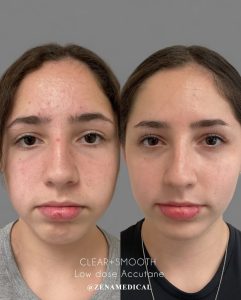
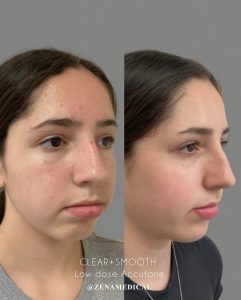
Low-Dose Accutane Treatment — in Newport Beach or virtually, with the dermatologist who built her practice around it.
Low-dose Accutane (isotretinoin) is a medical acne treatment that shrinks the oil glands driving breakouts, using a microdosed protocol — typically around 40 mg two to three times a week over six months to a year — instead of a high daily dose. At ZENA Medical it is managed by Dr. Zenovia Gabriel, who has specialized in low-dose isotretinoin protocols for over fifteen years, in person at Fashion Island in Newport Beach or by video consultation ($185).
Most people arrive here having already tried everything. Topicals, antibiotics, facials, changing their diet, changing their pillowcase. Acne is a medical disorder, not a surface condition, and it responds to medical treatment.
Dr. Gabriel has treated thousands of patients with low-dose protocols. If you’ve been reading about microdosing Accutane and want it managed by the dermatologist who built her practice around it, that’s what this page is for.
We treat patients in person at Fashion Island in Newport Beach, and virtually by video consultation. Request a consultation or call 949-200-8222.
Traditional isotretinoin dosing is roughly 1 to 2 mg per kilogram of body weight — typically 40 to 60 mg every day for about six months. It works, and it comes with the side effects most people associate with the drug.
Low-dose means microdosing rather than taking a high dose daily: in the region of 40 mg taken two to three times a week, over six months to a year. Your protocol depends on your acne type, your oil production and severity.
The result is the same destination by a gentler route — and for most patients, a route they can actually tolerate for as long as it takes. Read Dr. Gabriel’s full guide: The Truth About Low-Dose Accutane.
It decreases excess sebum production by shrinking the oil glands, eliminates active pimples, prevents new lesions from forming, and regulates the skin-shedding process that leads to clogged pores. It addresses the cause rather than the symptom, which is why other oral medications tend to work only partially while breakthrough acne continues.
Isotretinoin is effective across acne types, including:
If your acne is scarring, early treatment matters. Scars can last a lifetime; acne doesn’t have to.
Stage 1 — Oil reduction (months 1–2). Within the first month, oil production begins to decrease. Most patients notice their skin feels different before it looks different.
Stage 2 — Fewer pimples (months 2–3). Breakouts become less frequent and less inflamed.
Stage 3 — No new pimples (months 3–4). By month four, new pimple formation typically stops.
Stage 4 — Collagen remodelling. Skin balances, texture and smoothness improve, collagen begins to remodel and the surface takes on a healthy sheen. This continues after the course ends.
Residual red marks and hyperpigmentation take longer to resolve than the acne itself — that’s normal, and it’s not a sign treatment isn’t working. See the month-by-month detail in A Dermatologist’s Accutane Guide: Timeline and Expectations.
On traditional high-dose regimens, patients commonly experience excessive dryness and flaking, severe lip chapping, persistent facial redness, sun sensitivity, liver enzyme abnormalities, cholesterol and lipid disturbances, and joint pain. Monthly blood draws are needed to monitor triglycerides and liver function.
On our low-dose protocols, the most common side effect by a wide margin is dry lips. Patients experience markedly less dryness, and fewer issues with mood, headaches, liver values and triglycerides. Because low-dose isotretinoin is well tolerated and easily metabolised, routine monthly bloodwork is generally not required the way it is with traditional dosing.
We’ll tell you what to expect before you start, and we review how you’re doing at every check-in.
Isotretinoin must never be taken during pregnancy. It causes severe birth defects. This is the single non-negotiable rule of treatment, and it’s why the federal iPLEDGE programme exists — to prevent pregnancy during treatment. Patients who can become pregnant use two forms of contraception and test monthly throughout the course.
What iPLEDGE does not mean is that the medication harms your future fertility. It does not affect fertility, damage the ovaries or impact future pregnancies. There is no evidence that isotretinoin affects ovarian function. For patients who are not pregnant and not planning to be during treatment, this is a well-tolerated medication.
We handle the iPLEDGE paperwork with you. It’s administrative, and it’s the part patients worry about unnecessarily.
At our Newport Beach practice. Fashion Island, 359 San Miguel Drive, Suite 300 & 301. Consultation, monthly reviews, and scar treatment once your course is complete.
Virtually, by video. Consultation, prescribing and ongoing management by secure video, with any lab work arranged near you. For many patients this is the difference between starting treatment now and waiting months for a local dermatology appointment. Tell us where you’re located when you book and we’ll confirm what we can offer. More about virtual consultations →
A virtual consultation with Dr. Gabriel is $185. In-person consultation fees are confirmed when you book. Medical dermatology visits with Dr. Christina Ring may be covered by Anthem Blue Cross PPO, Blue Shield PPO, United Healthcare PPO or Medicare; visits with Dr. Gabriel are self-pay, and we provide a superbill you can submit to your PPO plan. The medication itself is dispensed by your pharmacy and priced separately — generic isotretinoin is widely available and frequently covered by insurance.
Accutane stops new acne forming; it doesn’t remove scarring left behind by earlier breakouts. Once your course is complete and your skin has settled, microneedling and Genius RF microneedling address texture and scarring — and we’d rather plan that with you than have you discover it later. See our acne scar treatments →
We’ll look at your skin and your history, tell you honestly whether Accutane is the right step, and if it is, explain exactly what your protocol looks like before you commit to anything.
Request a consultation below, or call 949-200-8222.
Medically reviewed by Dr. Zenovia Gabriel, board-certified dermatologist. Last updated September 2026.
Accutane is the brand name for isotretinoin, an oral medication that shrinks the oil glands driving acne. At ZENA Medical it is prescribed as a low-dose (microdosed) protocol for persistent, hormonal, cystic or scarring acne, managed in person in Newport Beach or virtually by video.
It starts with a dermatology consultation — in person or virtually. We assess your acne, review what you’ve already tried, decide together whether isotretinoin is the right step and which protocol suits you, then enrol you in iPLEDGE.
Microdosing isotretinoin rather than taking a high dose daily — in the region of 40 mg two to three times a week, over six months to a year, instead of 40 to 60 mg every day for six months.
Taken daily, 40 mg sits within the traditional range. Taken two to three times a week, the same 40 mg tablet becomes a low-dose protocol. The frequency matters more than the number on the tablet.
Oil production drops within the first month, breakouts reduce by months two to three, and new pimple formation typically stops by month four. Courses run six months to a year depending on your acne type, oil production and severity.
Yes. The most common side effect is dry lips. Patients see markedly less dryness, redness and disturbance to liver values and triglycerides than on traditional dosing.
Isotretinoin shrinks the oil glands that produce acne, which is why the results hold in a way antibiotics and topicals don’t.
No. It does not affect fertility, damage the ovaries or impact future pregnancies. It must never be taken while pregnant, which is what iPLEDGE exists to prevent.
For many patients, yes — consultation, iPLEDGE enrolment, prescribing and ongoing management can all be handled remotely, with lab work arranged near you. Tell us where you’re located when you request an appointment and we’ll confirm what’s possible.
Yes — a large share of our isotretinoin patients are adults, many with hormonal acne that began or returned in their thirties and forties.
Medical visits with Dr. Ring may be covered by Anthem Blue Cross PPO, Blue Shield PPO, United Healthcare PPO or Medicare; visits with Dr. Gabriel are self-pay with a superbill provided. Generic isotretinoin from your pharmacy is frequently covered by insurance.
Request a consultation and we’ll confirm the next available time, in person or virtually — usually far sooner than the wait at most dermatology practices.
At our Newport Beach practice. Fashion Island, 359 San Miguel Drive, Suite 300 & 301. Consultation, monthly reviews, and scar treatment once your course is complete.
Virtually, by video. Consultation, prescribing and ongoing management by secure video, with any lab work arranged near you. For many patients this is the difference between starting treatment now and waiting months for a local dermatology appointment. Tell us where you’re located when you book and we’ll confirm what we can offer. More about virtual consultations →
A virtual consultation with Dr. Gabriel is $185. In-person consultation fees are confirmed when you book. Medical dermatology visits with Dr. Christina Ring may be covered by Anthem Blue Cross PPO, Blue Shield PPO, United Healthcare PPO or Medicare; visits with Dr. Gabriel are self-pay, and we provide a superbill you can submit to your PPO plan. The medication itself is dispensed by your pharmacy and priced separately — generic isotretinoin is widely available and frequently covered by insurance.
Accutane stops new acne forming; it doesn’t remove scarring left behind by earlier breakouts. Once your course is complete and your skin has settled, microneedling and Genius RF microneedling address texture and scarring — and we’d rather plan that with you than have you discover it later. See our acne scar treatments →